We compared the three biggest Instagram timing studies, covering 1M+ posts (Hootsuite), 9.6M posts (Buffer) and nearly 2 billion engagements (Sprout Social), to find where they all agree. The short answer: Tuesday and Wednesday afternoons. Below, you will see where the studies clash and get a four-week test to find the slot that works for your followers.
The best time to post on Instagram: quick answer
Start with weekday afternoons and early evenings, especially Tuesday and Wednesday. That is the one pattern where Hootsuite, Buffer and Sprout Social overlap. Everything else is a guess until you test it on your own followers.
| Day | Hootsuite | Buffer | Sprout Social |
|---|---|---|---|
| Mon | 3–9 PM | 6–8 PM | 2–4 PM |
| Tue | 5–8 AM, 3–7 PM | 3, 5, 7 PM | 1–7 PM |
| Wed | 5 PM | 12 PM, 6 PM | 12–9 PM |
| Thu | 4–5 PM | 9 AM | 12–2 PM |
| Fri | around 4 PM | 9–10 PM | no clear peak |
| Sat | 11 AM, 5 PM | 8–10 PM | weakest day |
| Sun | 12–3 PM | 8–10 PM | among the worst |
Times are your audience’s local time. Each study’s numbers come from its own page.
Best time to post by day of the week
I turned the table above into a heatmap. Each cell counts how many of the three studies list a good window in that part of the day. Darker means more agreement. It shows agreement, not how big the engagement was.
5–11Midday
12–2Afternoon
3–6Evening
7–10 Mon0132 Tue1133 Wed1231 Thu1110 Fri1011 Sat1011 Sun0111
Compiled from Hootsuite, Buffer and Sprout Social’s published windows.
Add up each row and the picture gets clearer. Tuesday and Wednesday have the most overlap. Thursday to Sunday have the least.
Agreement score = the heatmap row total. Higher means more studies point to the same day.
Tuesday (3–7 PM) is the safest slot. All three studies have a window here. Wednesday (around 5–6 PM) is next. Buffer also finds a lunchtime spike around noon. Thursday is messy: one study says 9 AM, one says lunch, one says 4–5 PM. Test it yourself before you trust any of them.
Fridays and weekends are the weakest in Buffer and Sprout Social. Save your best posts for midweek and use the weekend for lighter content.
Why the big studies disagree
They are not measuring the same thing, so the answers differ. Here is what sits behind each one.
| Hootsuite | Buffer | Sprout Social | |
|---|---|---|---|
| Sample | 1M+ posts | 9.6M Instagram posts | ~2B engagements, ~307K profiles, six networks |
| Period | Mixed (some charts labeled Q4 2024) | Jan 2024 – Dec 2025 | 27 Nov 2025 – 27 Feb 2026 |
| Metric | Engagement (not defined on the page) | Median engagement rate | Total engagements |
Two things matter most. Sprout’s window sits over the winter holidays, so it may not fit your audience in other months. And all three datasets come from brands and marketers using scheduling tools, not from small personal creators. Treat them as a starting line, not a rule.
Reels, carousels and Stories
Here is what is actually known. Sprout says Reels follow the same windows as photos. Buffer says it did not split formats, so its Reels advice is an educated guess: evenings, when people have time to watch and send posts to friends. Nobody has hard format-by-format numbers, so test your own.
For Stories, consistency beats the perfect minute. Buffer suggests 1–2 a day and 3–5 feed posts a week. For a quick tour of what each format does, see Instagram features. Want a copy of your own best clips before you test new slots? You can save your own Reels first.
Time zones and audience location
These studies use your audience’s local time, not yours. If most of your followers live in another country, convert the time before you schedule anything.
Example: your audience is in London and the target slot is 7 PM GMT. If you are in Dubai (4 hours ahead), post at 11 PM your time. Daylight saving changes these gaps, so check the current offset.
Not sure where your followers are? Open your Insights audience tab, take your top two countries, and aim for the overlap or alternate between them.
Post 30 to 60 minutes before the peak
Buffer quotes Instagram’s head, Adam Mosseri, suggesting you post a little before your audience arrives so the post is already live when they open the app. So if your followers peak at 7 PM, try 6 PM.
Test this against posting right at the peak. Your data decides.
What to do in the first 60 minutes
- Reply to early comments quickly.
- Share the post to your Story.
- Send it to a few friends who would genuinely like it.
Early interaction tells Instagram people care about the post. Skip fake engagement; it does not help and can hurt. For the full picture, see how the Instagram algorithm works.
The same goes for “free IG followers” offers. Fake accounts never engage, which drags down the very rate these timing studies measure. To grow for real, read how to get more Instagram followers.
How to find your own best time
Instagram’s free Insights show when your followers are online. Go to your profile, tap Professional dashboard, then New followers, and scroll to the most active times. Instagram changes menus, so check the Help Center if yours looks different.
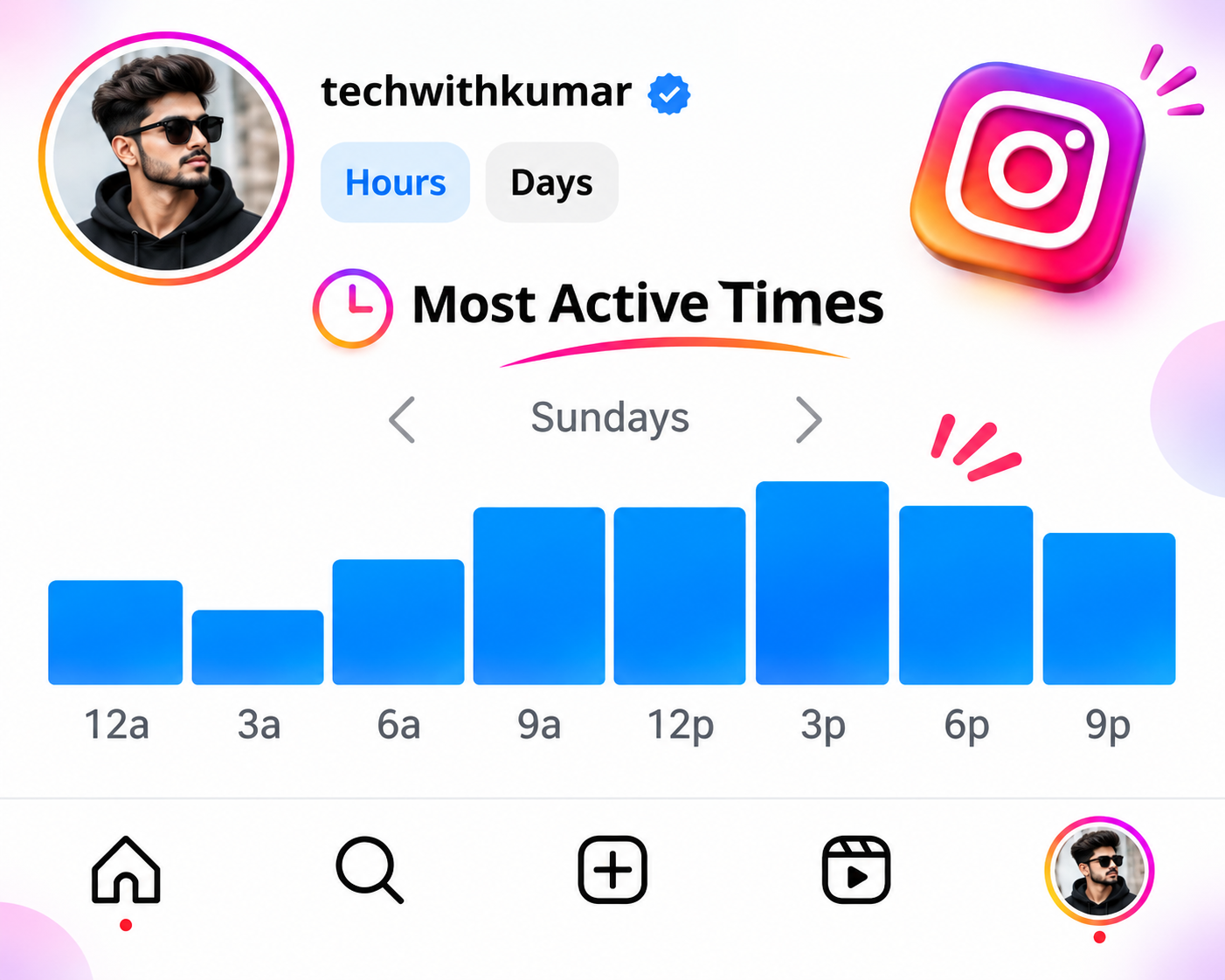
You need a professional (Creator or Business) account to see this, and it is free to switch to a professional account. New here? Pick a handle first with these Instagram username ideas. One catch: “most active” means followers are online, not that they will like or comment. With under 100 followers, start with the consensus slots and check each post’s results after 24 hours.
A 4-week test to find your best time
Keep the format, topic and caption style similar so timing is the only thing that changes. Use two slots per week and compare the median reach, not the average, so one lucky post does not mislead you.
| Slot | Posts | Median reach | Saves + shares |
|---|---|---|---|
| Tue 6 PM | 4 | 1,200 | 38 |
| Wed 12 PM | 4 | 950 | 22 |
| Thu 9 AM | 4 | 780 | 15 |
Example numbers for a made-up food creator. Replace them with yours.
In this example, Tuesday 6 PM wins, so the creator keeps it and tests a new challenger slot next month. Re-test after holidays, exam seasons or any big change in your audience.
FAQ
What is the best time to post on Instagram today?
Check the table above for today’s weekday. If it is Tuesday or Wednesday, aim for the late afternoon or early evening in your audience’s local time.
What is the worst time to post?
Overnight is weak in Buffer’s data, and Sprout flags 3–7 AM as a dead zone. Fridays and weekends are also weak in two of the three studies.
Does posting time really matter?
It helps, but good content matters more. Think of timing as a small boost, not a fix for a weak post.
How often should I post?
Buffer’s data points to 3–5 feed posts a week plus 1–2 Stories a day.
How long should I test before changing my schedule?
Four weeks is a fair start. Small accounts are noisy, so look for a pattern across several posts, not one result.
Conclusion
Choose two slots from the heatmap, run the four-week test, and keep the winner. Your followers’ habits matter more than any study, including this one. Once your timing works, the next step is to get verified on Instagram.